100 MOMENTS FOR 100 DAYS TO GO UNTIL THE 2026 bp ADELAIDE GRAND FINAL

bp Adelaide Grand Final

18 Aug 2026
With 100 days to go to the bp Adelaide Grand Final – with the countdown presented by SIMBA Car Hire – we take a trip down memory lane to look back at 100 moments from the history of the event from 1999 to today.
1. A new event is born. In September 1998 the South Australian government struck a deal to run a Supercars race on a shortened version of the old Adelaide Grand Prix circuit.
2. A modest start. The initial contract ran for five years, with an option for a further five. But following the immediate success of the first event, the race soon became a regular fixture on the Supercars calendar.
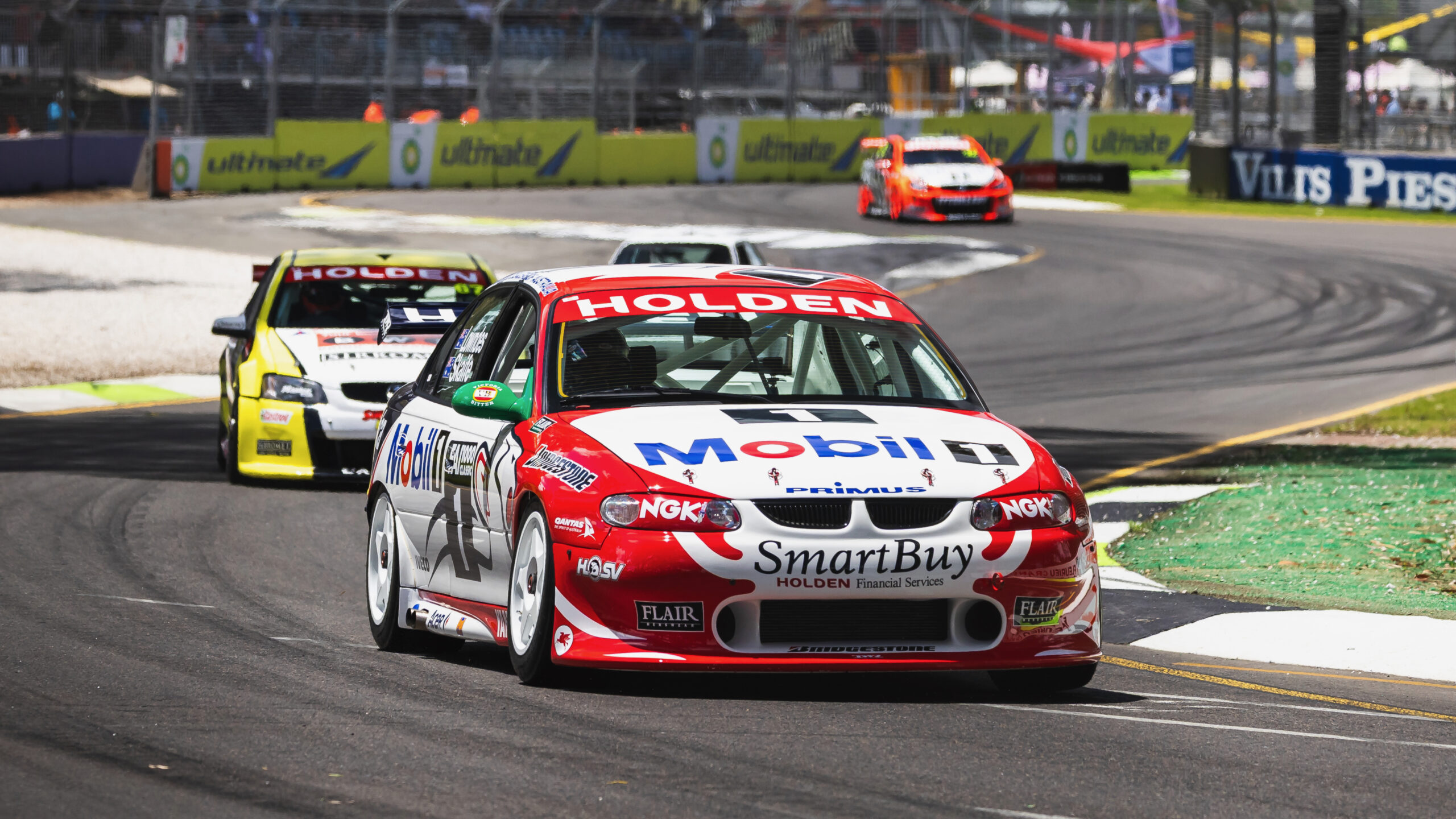
3. Craig Lowndes wins the inaugural race. Lowndes won the 1999 Saturday leg but was disqualified over a clash with Danny Osborne, sending him to the back of Sunday’s grid.
4. Last to first. From the back of the field, Lowndes sliced through the field to win the Sunday race and become the first-ever Adelaide 500 champion – his only event win in Adelaide.
5. Rules rewritten overnight. The 1999 event was meant to be a single 500km race split over two days, but when a swathe of star cars retired in the first leg, organisers changed the regulations overnight to let them start the Sunday race anyway.
6. A brutal introduction to the heat. The debut event proved such a physical test that the likes of Paul Radisich and John Faulkner needed medical attention for dehydration.
7. A first for women. South Australian Kerryn Brewer became the first woman to race in the Adelaide 500, driving a Holden Commodore in the inaugural 1999 event.
8. A packed support bill from the start. Over the years, categories supporting the main game have included the Super2 Series, SuperUtes, Touring Car Masters, Australian GT, Carrera Cup and so much more.
9. Bumper crowd from the start. With 158,000 spectators across the weekend, including 64,000 on the Sunday, the inaugural event broke the record for the largest Australian Touring Car Championship/Supercars event crowd at the time.
10. Mark Skaife’s great escape. In 2000, Skaife won the Sunday race after starting towards the rear of the field following a Saturday DNF – one of the event’s great fightbacks.
11. The one exception. Despite Skaife’s Sunday win, Garth Tander was awarded the 2000 event victory with the most points across the two races – the only time in the race’s history that the Sunday winner wasn’t given the overall win.
12. Brad Jones goes over. Jones rolled his Ford Falcon at the original Turn 8 in 2000, one of several incidents that would prompt a redesign of the corner.
13. Lowndes switches to Ford. In 2001, Lowndes won his first race for Ford after defecting from the Holden Racing Team to a Gibson Motorsport Falcon.
14. So close, then gone. Lowndes was in contention to add a Sunday win in 2001 until a clash with former teammate Skaife ended his charge.
15. Season opener move. The Adelaide 500 moved to the start of the Supercars season in 2002, establishing itself as the first event of the year.
16. Turn 8 reprofiled. Turn 8 was re-profiled into a fast, concrete-lined right-hand sweeper, immediately becoming one of the most feared and infamous corners in Australian motorsport, heavy crashes by drivers like Paul Radisich and Glenn Seton in 2002.
17. Racing off-site. Capacity constraints and a huge field meant 2002 pre-qualifying was held away from Adelaide, at Mallala Motor Sport Park.
18. Introduction of ‘Project Blueprint’. The 2003 Adelaide marked the start of the ‘Project Blueprint’ regulations in Supercars, in a bid to create better parity between the Holden Commodore and Ford Falcon.
19. Holden’s clean sweep. From 1999 to 2003, Holden drivers won every Adelaide 500, with Skaife, Jason Bright and Tander adding wins to Lowndes’ opener.
20. Ford finally breaks through. In 2004, Marcos Ambrose won both races to become the first Ford driver to claim the event.
21. Turn 8 pileup. The 2004 Adelaide 500 saw one of the biggest multi-car accidents at Turn 8, with Cameron McConville, Jason Bargwanna, Brad Jones and Steven Johnson all caught up.
22. Best event, six years running. The Adelaide 500 was named best event on the Supercars calendar every year from 1999 to 2004.
23. Ambrose does it again. Ambrose repeated the feat in 2005, winning back-to-back Adelaide 500s, after announcing his departure from Supercars to NASCAR at the end of that season.
24. A Ford top four. The 2005 Saturday race saw Ford cars fill the entire top four – a striking reversal of Holden’s early dominance.
25. Hall of Fame honour. In 2005 the Clipsal 500 became the first individual event inducted into the Supercars Hall of Fame.
26. Whincup arrives. In 2006, Jamie Whincup won on his very first appearance for Triple Eight Race Engineering – his maiden Supercars victory, at the start of a legendary partnership.
27. Turn 8 claims Holden heroes. Holden heavyweights Mark Skaife and Greg Murphy suffered a dramatic and infamous dual accident when both their Commodores slammed into the unforgiving concrete barriers at Turn 8.
28. Chicane collision. On a bruising weekend for the favourites, Craig Lowndes, James Courtney and Cameron McConville collided heavily on the exit of the Senna Chicane. For Courtney, it was a second crash in as many races in his debut with Stone Brothers Racing.
29. A split decision. In 2007, brothers Todd and Rick Kelly each won a race across the weekend, but Rick was awarded the event win for his Sunday victory.
30. Whincup’s first repeat. Whincup won again in 2008, the first of what would become a run of Adelaide victories.
31. Tenth running. The 2008 event marked the 10th running of the Adelaide 500, having firmly establishing itself as the Supercars season opener.
32. A record crowd. Some 291,400 people attended the 2008 event, the largest crowd recorded for a domestic motorsport event in Australia.
33. Tourism awards galore. Adelaide’s event won the “Major Festivals & Events” category at the Australian Tourism Awards in 2003/04, 2005, 2007 and 2008.
34. Whincup, three from four. Whincup won a third Adelaide title in 2009, cementing his status as the event’s dominant driver.
35. Pit building and grandstand upgrades. The 2009 event saw the introduction of a new pit building and bigger grandstands, with the latter including shaded areas for crowd comfort.
36. A tight finish. Whincup beat Will Davison by just 0.7479 seconds in the 2009 Sunday race, one of closest finishes in the event’s history.
37. Losing pole position on the calendar. Adelaide lost its status as season opener in 2010 and 2011, ceding the honour to the Yas V8 400 in Abu Dhabi, but Adelaide remained the first Australian event on the calendar.
38. A fuel-mileage classic. Tander claimed a second Adelaide win in 2010 after Whincup was black-flagged for loose bodywork during a tense fuel-strategy battle.
39. The closest finish in event history. In 2011, Tander beat Whincup by a mere 0.5420 seconds — still the tightest margin ever recorded at Adelaide.
40. Rain returns. The 2011 Sunday race was the first wet Adelaide race in more than a decade, and Whincup used the tricky conditions to turn the tables on Tander.
41. A fourth crown. Whincup’s 2011 win made him the event’s only four-time event winner, a record that still stands.
42. A repeat honour. In 2011, the event again won Best Event of the Year, after years of ineligibility following its 2005 Hall of Fame induction.
43. Back on top of the calendar. From 2012, Adelaide reclaimed its place as the season-opening round.
44. A last-lap heartbreaker. In 2012, Whincup chased down and passed a fuel-starved Davison on the final lap of the Saturday race in one of the event’s most dramatic finishes.
45. Davison’s redemption. Despite the Saturday loss, Davison won the 2012 Sunday race and the overall event – his first event win on the streets of Adelaide.
46. Murphy misses with back injury. Greg Murphy and Jonathon Webb were ruled out of the Sunday race following a huge qualifying crash. A back injury sustained in the crash forced Murphy to miss multiple events in 2012.
47. New manufacturers arrive. The 2013 event saw the debut of the ‘Car of the Future’ regulations, bringing Nissan and AMG Mercedes-Benz into Supercars with their competitive debut in Adelaide.
48. A controversial comeback pays off. Shane van Gisbergen won the 2013 Sunday race for Tekno Autosports, months after a switch away from a planned retirement caused a stir.
49. Stoner mania. Two-time MotoGP world champion Casey Stoner made his highly anticipated professional four-wheel racing debut in the Super2 Series at the 2013 Adelaide 500, for what would be his only season racing a Supercar.
50. A three-race format experiment. Between 2014 and 2016 the event ran two 125km races and one 250km race on Sunday, before reverting to the classic two-by-250km format.
51. Volvo joins the grid. The Swedish manufacturer entered Supercars for 2014, making an immediate mark.
52. McLaughlin announces himself. On the Volvo’s debut, young gun Scott McLaughlin fought off Whincup on the final lap of the newly introduced second Saturday race to finish second, endearing himself to the crowd with his expletives post-race.
53. History repeats for Brad Jones Racing. Jason Bright rolled his Brad Jones Racing Holden Commodore at the Senna Chicane in 2014, 14 years after his own team boss Brad Jones had rolled at the old Turn 8.
54. Courtney triumphs. James Courtney won the 2014 event for the Holden Racing Team, a long-awaited Adelaide triumph for the former Supercars champion. Courtney’s win over Lowndes was by a mere 0.6658-second margin.
55. Back-to-back for Courtney. Courtney repeated in 2015, becoming just the fourth driver – after Skaife, Ambrose and Whincup – to win Adelaide in consecutive years.
56. Ambrose returns. Ford’s most successful Adelaide 500 driver Marcos Ambrose made his comeback to the event in 2015 with the rebranded DJR Team Penske. It proved to be Ambrose’s one and only solo event of 2015.
57. Stadium Super Trucks debut. Stadium Super Trucks made their historic Australian and international debut at the Adelaide 500 2015, immediately becoming one of the most popular support categories at the event.
58. Chaos in the rain. The 2016 Sunday race was hit by thunderstorms, a delayed start behind the safety car, confusion over fuel-drop rules and a red flag that cut the race short.
59. Percat’s shock win. Adelaide’s own Nick Percat splashed to victory in the 2016 downpour, the only Adelaide winner in the history of the event and the sole win for Lucas Dumbrell Motorsport.
60. Nissan’s championship lead. Following a chaotic weekend of racing, Nissan driver Michael Caruso left Adelaide with the championship lead. It marked the first time a non-Holden or Ford driver was winning the title race after the Adelaide season opener.
61. A clean sweep. Van Gisbergen won both races at the 2017 event, kicking off four straight years of New Zealand drivers taking the Adelaide title.
62. The youngest ever. At just 16, Alex Rullo made his Supercars debut at the 2017 Adelaide 500, becoming the youngest driver in the category’s history.
63. A first for full-time female drivers. Simona de Silvestro debuted as a full-time driver at the same event, the first woman to contest a full Supercars season since 1998.
64. Scott McLaughlin joins DJR Team Penske. McLaughlin made his debut with DJR Team Penske in Adelaide in 2017, with a podium in the second race with the combination going on to dominate the event in future years.
65. A milestone round. Lucas Dumbrell Motorsport started its 100th Supercars round at the 2017 Adelaide 500 – on the same street circuit where it had scored the team’s maiden race win the year before with Nick Percat.
66. The format reverts. The Adelaide 500 switched back to the two 250km race format for 2017.
67. Van Gisbergen does it again. The Kiwi dominator swept both 2018 races, taking four poles and four wins across the two years.
68. A winning debut for the ZB. The new Holden ZB Commodore claimed victory on its very first Adelaide appearance in 2018 – a winning start for Holden’s last Commodore.
69. Twenty not out. The 2018 event marked the 20th running of the Adelaide 500.
70. The Mustang returns. Scott McLaughlin won the 2019 season opener on the championship debut of the new Ford Mustang.
71. History for the Mustang nameplate. It was the model’s first championship race and round win since Allan Moffat’s victory at Oran Park back in 1972.
72. An echo from 1985. McLaughlin’s team co-owner Dick Johnson had himself won a non-championship race at the same Adelaide Street Circuit in a Mustang in 1985.
73. Jones’ frightening crash. Macauley Jones suffered a massive, high-speed impact during a practice session following a total brake failure as he approached Turn 9.
74. Pitlane chaos. Chaz Mostert and Rick Kelly tangled in pitlane in the Sunday race of the 2019 Adelaide 500, causing a chaotic logjam with most of the field also in pitlane.
75. Holden’s shock announcement. Days before the 2020 Adelaide 500, General Motors announced it would retire the Holden brand by year’s end.
76. A tribute win. Whincup won the 2020 Saturday race and dedicated the victory to Holden.
77. Fuel gamble backfires. Van Gisbergen led the 2020 Sunday race until a team error forced an extra pitstop, followed by a mechanical failure that ended his day.
78. Back-to-back for McLaughlin. McLaughlin capitalised to win Sunday and claim consecutive Adelaide event victories.
79. The event is axed. In October 2020, the event was axed by the Liberal state government, citing COVID-19 challenges.
80. A campaign to bring it back. Opposition leader Peter Malinauskas launched a petition and campaign pledging to restore the race if elected.
81. The race returns. Following Malinauskas’ 2022 election win, the Adelaide 500 returned to the calendar – now as the season finale – rather than the season-opening slot.
82. Mostert opens the new era. Chaz Mostert won the Saturday race of the comeback event for Walkinshaw Andretti United, an emotional win for the team that was the Holden Racing Team in Holden’s last-ever Supercars event.
83. A rookie’s maiden win. Broc Feeney won the 2022 Sunday race for Triple Eight, his first Supercars victory and the last for Holden in the make’s final Supercars race.
84. Van Gisbergen’s championship burnout. Van Gisbergen celebrated his 2022 Supercars championship win with an epic burnout celebration on the pit straight, creating a new tradition for the event in its season-ending slot.
85. Waters prevails. Cameron Waters took the opening race of the 2023 event for Tickford Racing, his first-ever race win at the Adelaide 500.
86. Payne’s fairytale. Rookie Matt Payne led the 2023 Adelaide finale from lights to flag for his maiden Supercars win. Payne’s win echoed Feeney’s the year before – back-to-back breakthrough winners in the Adelaide finale.
87. Van Gisbergen’s Australian farewell. The 2023 finale was van Gisbergen’s last full-time Supercars start before his move to NASCAR.
88. A champion crowned. Brodie Kostecki was crowned 2023 Supercars champion in Adelaide, the first driver to secure a title at the event.
89. Feeney’s sixth of the season. Broc Feeney won the 2024 Saturday race, his sixth win of that campaign.
90. Brown crowned champion. Will Brown secured his maiden Supercars title on the Saturday of the 2024 Adelaide event.
91. From 22nd to victory. A day later, Brown recovered from a spin that dropped him down the field to storm through and win the chaotic Sunday finale.
92. Turn 8 chaos. Cameron Hill, David Reynolds and Richie Stanway all sustained heavy impact damage with crashes at Turn 8 in a chaotic qualifying session.
93. Grand Final format introduced. The event became the bp Adelaide Grand Final as part of Supercars’ new finals format, with the introduction of a 100km Friday race in addition to the Saturday and Sunday 250km races. Four drivers were in contention for the title under the new format – Mostert, Feeney, Brown and Kai Allen.
94. Kostecki’s big pay day. Kostecki upstaged the championship finalists in Friday’s opening race, winning the $50,000 prize thanks to Mega Rewards.
95. Championship advantage to Feeney. Feeney took the points lead heading into the final race of the 2025 event following victory in the Saturday race. Having led for most of the season, Feeney looked on course for his championship win.
96. Mostert’s title. Chaz Mostert was crowned 2025 Supercars champion at the Adelaide finale, in a controversial decider following a collision between Feeney and Ryan Wood. It was a long-awaited first title for Mostert.
97. Payne wins again. Matt Payne claimed a second Adelaide victory in three years at the 2025 finale, again showing dominant form on the street circuit.
98. 40th anniversary celebrations. The 2025 marked the 40th anniversary since the first motorsport event on the Adelaide Street Circuit, the Australian Formula 1 Grand Prix, in 1985. A parade of cars representing the various categories that have raced on the circuit.
99. Huge concert acts. AC/DC and Lenny Kravtiz headlined the after-race concerts at the 2025 bp Adelaide Grand Final. The honour role of major music acts who have performed at the event include KISS, Mötley Crüe, Santana, Keith Urban, Rob Thomas, Red Hot Chili Peppers, Cold Chisel and so many more.
100. Event launch. Hollywood star and motorsport fan Eric Bana made a star appearance in the 2026 bp Adelaide Grand Final commercial, as excitement builds for the second running of the grand final format.
Get your tickets for the 2026 bp Adelaide Grand Final HERE.